How to review a gut feeling after you know the outcome
Open the note you wrote before the decision. Copy the exact prediction onto a fresh line, then write what happened underneath it. Give yourself two answers: How accurate was the prediction? Given what you knew at the time, would you make the same decision again?
By Denys Kostin ·
What did you actually predict?
“Something will go wrong” can fit almost any difficult week. “The receiving team will miss Friday’s handoff because nobody owns acceptance testing” gives you a date, an event and a suspected cause. Check each detail separately. If you only wrote the first version, mark it too vague to assess. You can still record what surprised you.
When your prediction comes true for a different reason
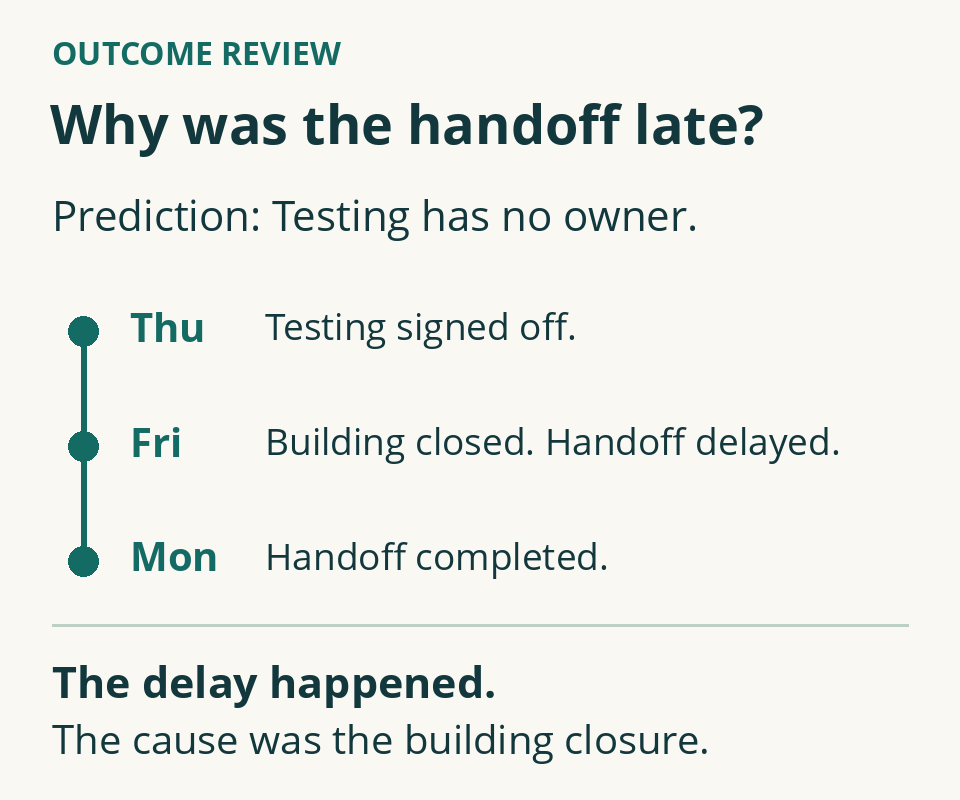
Imagine you wrote the Friday handoff prediction. On Monday you learn that the receiver signed off on testing on Thursday. A building closure on Friday delayed the physical handoff until Monday.
Journal entry. “I got the timing right. The testing record contradicts my explanation. Next time I suspect an ownership gap, I’ll check the acceptance log before escalating.”
The delay is real. Counting it as evidence that you can spot missing owners would teach you the wrong lesson. If nobody can establish what caused the delay, leave the cause open.
When a sensible decision turns out badly
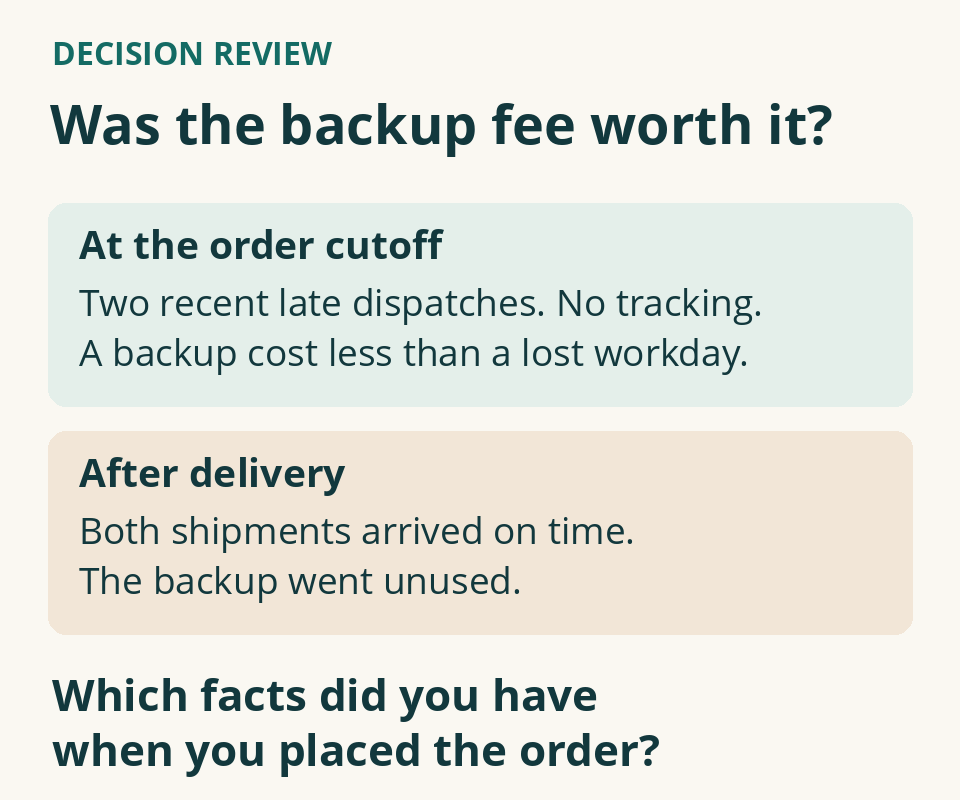
Suppose a supplier has missed two recent dispatches. You pay for a backup shipment because the cost is small compared with a day of lost production. Both shipments arrive on time. The extra fee bought you nothing on this occasion.
Journal entry. “I expected the first shipment to arrive late. It arrived on time. When I placed the backup order I had two dispatch records, no tracking confirmation and a noon cutoff. Next time I’ll ask whether tracking will be available before the cutoff.”
You can record a missed prediction and still give a reason for the precaution. To decide whether to repeat it, look back at the cost, the deadline and the alternatives that were available then.
A short outcome review you can copy
- My original words. What did I expect, and by when?
- What happened. Which dated observation lets me check the prediction?
- My explanation. Which clue held up? What remains uncertain?
- My decision. Given the information and options I had then, would I make the same choice?
- Next time. What specific question will I ask earlier?
If the review date arrives before the outcome is known, record what you are still waiting for and set another date. If you never wrote down a prediction, label your account as a recollection. Start a dated entry for the next decision.
For a job decision you can follow from first impression to follow-up, read the completed gut feeling journal example. To record a fresh prediction, open the free signal log and choose a review date while the decision is still open.