Intensity versus reliability: how to check a strong feeling
Intensity describes how strongly you feel something. Reliability concerns how well a judgment holds up against evidence across comparable situations. A single vivid feeling cannot establish a track record.
By Denys Kostin · Updated
The difference at a glance
| Dimension | Intensity | Reliability |
|---|---|---|
| Question | How strongly do I feel this? | How well is this judgment supported? |
| What to observe | Subjective strength and urgency | Comparable predictions, outcomes, and feedback |
| Main limitation | Strength is not proof of accuracy | Past performance may not transfer to a new setting |
| Useful response | Notice and name the impression | Check the evidence and the conditions |
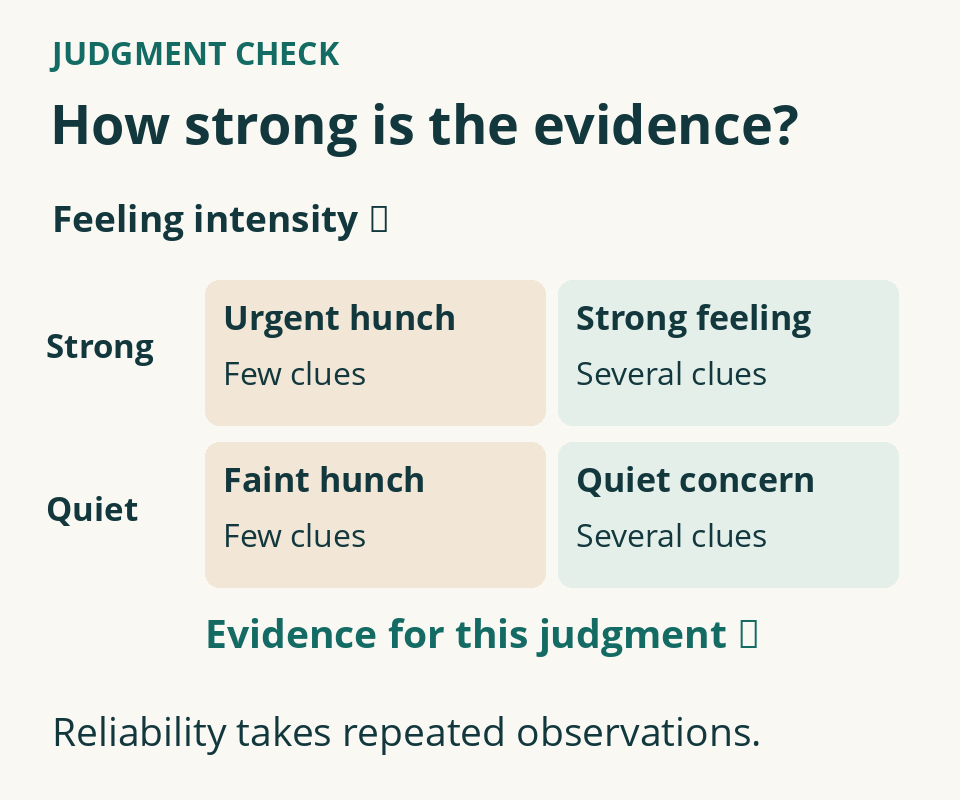
Strong feeling, weak evidence
A presentation feels convincing because its speaker is confident and its story is easy to follow. You predict the proposed process will reduce delays. Yet no baseline, trial result, or implementation cost has been shown.
The appropriate next step is to request the missing evidence or run a bounded trial. Feeling persuaded is a fact about your reaction, not a measurement of the proposal’s effectiveness.
Strong feeling, useful evidence
An experienced coordinator recognizes a familiar combination of unresolved dependencies and missing owners. Their concern is supported by records from comparable work, including cases where the warning was wrong. They check whether the same conditions apply now.
Here the feeling may point toward something worth investigating. The supporting records and current observations carry the argument. The intensity does not.
A quiet impression can also be wrong
Calmness is not an accuracy test. You may quietly assume that an established process still works while overlooking a change in staffing or requirements. Review the current conditions even when a judgment feels familiar and untroubled.
Build a record you can actually review
- Write a specific prediction before the outcome occurs.
- Record the observations and your interpretation separately.
- Include plausible alternatives and evidence against the prediction.
- Set a date and an observable criterion for reviewing it.
- Record misses and unresolved cases as carefully as successes.
Use the downloadable signal log to keep these entries together. See how a candidate recorded the prediction and the outcome in this job offer journal example. Do not estimate your reliability from a few memorable successes.
Review the decision and the outcome separately
A well-supported decision can have a disappointing result. A poorly supported decision can work out by chance. Ask what was knowable at the time, whether the evidence justified the action, and whether your intervention changed what happened.
If you predicted a missed deadline and then removed the bottleneck, the deadline being met is not a clean test of what would have happened without your intervention. Mark that case as affected by your action instead of forcing it into a simple right-or-wrong count.
Try the comparison on your own decision
Write two sentences: “I feel strongly that…” and “The evidence I have is…”. If the second sentence repeats the feeling, you have found a question to investigate.
Continue with the on-site decision check, or read what the surer intelligence framework means.
Continue through the ecosystem
Surer Intelligence is part of a connected set of projects about noticing signals, examining judgments, and learning from experience. Choose the next step that fits your question.
Use the signal log on this site to connect what you notice with what you can check. Return to your original prediction when you review the outcome.
Research and limits
Kahneman and Klein’s 2009 paper, Conditions for intuitive expertise: A failure to disagree, identifies the predictability of a setting and opportunities to learn its patterns as central to evaluating intuitive expertise. Feeling certain is not itself evidence of accuracy.
The checklist and examples on this site are editorial teaching tools by Denys Kostin. They have not been validated as a psychological test or an accuracy score. Examples are illustrative, not research findings.